REVIEW · SPLIT
Best of Split & Trogir: Private VIP Tour with Local Guide
Book on Viator →Operated by Discovery tours · Bookable on Viator
Two cities in one guided loop. You’ll link Diocletian’s Palace in Split to UNESCO Trogir without spending the day lost in crowds.
What I like most is the way a local guide turns the sights into a flowing story, not a memorization project, and how the timing keeps things moving. In the best moments, guides like Kristina add personal tradition-based stories, and Andrea helps you get your bearings fast in the palace maze.
One consideration: this is a fast-hit tour. With short stops (around 15 minutes each at many locations), you’ll want extra time later if you love slow church visits or detailed museum-style looking.
In This Review
- Key highlights at a glance
- Why this VIP Split and Trogir route feels easier than going solo
- Split’s Diocletian’s Palace: Peristyle and the heart of the imperial complex
- Cathedral of Saint Domnius: the church that links you to early Christianity
- Grgur Ninski statue: a simple tradition with a goofy, satisfying payoff
- Temple of Jupiter inside Diocletian’s Palace: Roman power in plain sight
- Diocletian’s Palace substructures: when the basement turns into the main event
- Crossing to Trogir: central square and the feel of Venetian Dalmatia
- St Lawrence’s Cathedral: Romanesque-Gothic layers you can spot with the right guide
- Kamerlengo Fortress: best views for your time in Trogir
- Town Loggia and Čipiko Palace: where civic life and power showed up
- Price and time: what $228.78 buys you (and what it doesn’t)
- Who this tour suits best (and who should choose something else)
- Should you book this VIP Split and Trogir tour?
- FAQ
- How long is the tour?
- Is this tour private?
- Is pickup offered?
- Is the tour in English?
- Are entrance tickets included?
- Does the tour include a mobile ticket?
- Can I cancel and get a refund?
Key highlights at a glance
- Private VIP format: only your group, with an English-speaking local guide
- Fast pacing, short stops: about 6 hours total, with roughly 15 minutes at many stops
- Ticket-free wins early: the Peristyle and the Grgur Ninski statue are listed as free
- Roman + Venetian layers: Temple of Jupiter plus Trogir’s Italianate waterfront architecture
- City views without a long hike: Kamerlengo Fortress for sweeping old-town sightlines
- Mobile ticket and pickup offered: easier day-of logistics
Why this VIP Split and Trogir route feels easier than going solo
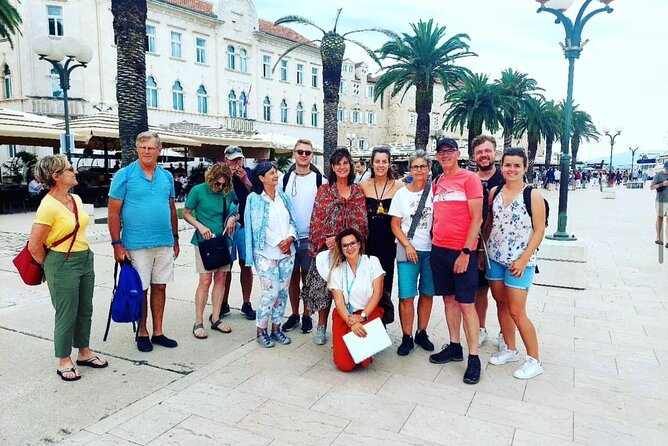
Split and Trogir are both packed with “wow” stops, but trying to piece them together yourself can turn into a time-sink. This tour solves that with a straight-line flow: you start in Split’s Diocletian core, then shift to Trogir’s historic center. The private setup also means you’re not stuck waiting while a larger group argues over directions.
I also like that the experience is built around a mix of must-sees and practical breathing room. Many key highlights are scheduled for about 15 minutes, which is just enough time to absorb the basics, take a few photos, and move on before you burn your energy. If you want the iconic sights without turning the day into a marathon, this kind of structure helps.
And because it’s an English tour with mobile ticketing and pickup offered, you cut down on the annoying parts of travel. You still get the history, but you spend less time wrangling schedules.
You can also read our reviews of more guided tours in Split


Split’s Diocletian’s Palace: Peristyle and the heart of the imperial complex
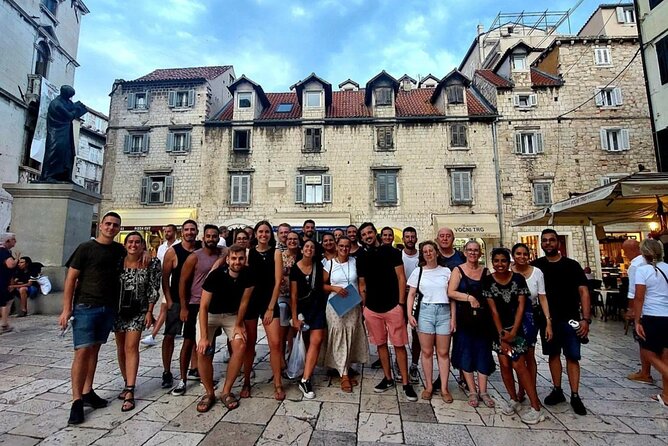
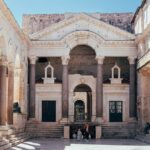
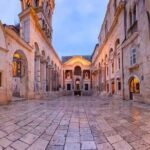
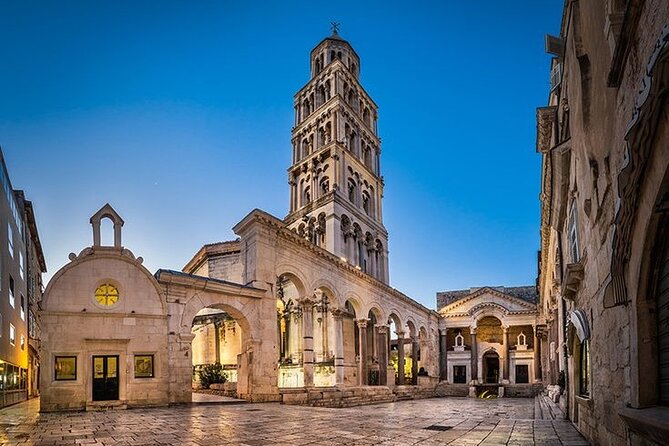
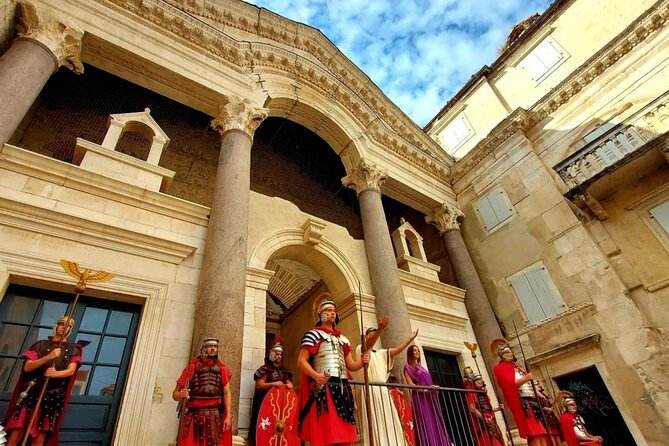
Your first big anchor is the Peristyle, the rectangular open court at the crossroads of the palace’s two main roads. It’s one of those spaces that makes the whole place click: you can almost feel how a Roman emperor’s private world became the city’s public center over centuries.
The Peristyle is listed as free, so it’s a great “warm-up” stop. You’re not paying extra to start, and you’re also landing in a spot that sets the tone for everything else you’ll see. Look for the colonnade framing the open court. That geometry matters here, because it reflects how Diocletian’s palace was planned as a controlled, functional world, not just a collection of impressive stones.
If you’ve seen photos of Split that look like they were taken from a postcard angle, this is the sort of location that creates that effect. The guide helps you understand what you’re looking at, so the details make sense instead of feeling random.
Cathedral of Saint Domnius: the church that links you to early Christianity
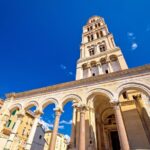
Next comes the Cathedral of Saint Domnius (consecrated around the turn of the 7th century AD). What makes it standout is the claim that it remains in use in its original structure with no near-complete renovation at a later date, even if later changes happened (like the bell tower from the 12th century).
Even if you’re not a hardcore architecture person, this stop rewards you. You’re seeing a working Catholic cathedral with layers of time still visible in the fabric. The early-Christian-to-medieval timeline is something you can feel simply by understanding the building’s age and how the changes arrived later.
A practical note: the itinerary doesn’t label an admission ticket here as free or not included. So if you’re sensitive to fees, it’s smart to expect that some church spaces may have their own ticket or donation rules. Your guide will help you navigate that on the spot.
Grgur Ninski statue: a simple tradition with a goofy, satisfying payoff
At Grgur Ninski (Gregory of Nin), you’ll find an 8.5-meter statue by Ivan Meštrović. The toe is the star. There’s a well-known tradition: rubbing the statue’s toe is said to bring good luck. The toe is worn smooth and shiny because people have been doing it for ages.
This is the kind of stop that’s short but memorable. You’re not reading a long plaque to get the point. You just see the toe, you learn the story, and you can decide whether you want to join the ritual. It’s also a nice change from purely architectural looking, because it adds a human moment to the day.
It’s listed as a free stop too, so you’re getting a fun cultural tradition without extra cost. And because the statue sits in the flow of Split’s central streets, it’s easy to slot into a tight schedule.
Temple of Jupiter inside Diocletian’s Palace: Roman power in plain sight
You then move to the Temple of Jupiter (Jupiterov hram), located in the western part of Diocletian’s Palace near the Peristyle. It’s a Roman temple built between 295 and 305, during the palace’s construction, dedicated to Jupiter.
This stop helps you understand that Diocletian’s complex wasn’t only about residences and administration. It also contained religious space, built into the palace plan. That makes the palace feel like a complete system, not just a fortress-like shell.
Here’s what makes it satisfying: it connects the “big idea” of the palace with a specific Roman faith center. If you’re the kind of traveler who likes history that has a physical address, this is one of those moments.
Admission here isn’t marked as free or not included in the itinerary details provided. So plan as if you might need an entry fee, depending on the temple’s current visitor rules.
You can also read our reviews of more private tours in Split

Diocletian’s Palace substructures: when the basement turns into the main event
The tour also includes the Diocletian Palace substructures, often described as the cellars or basement halls. These are at the southern end of Diocletian’s Palace and relate to the private apartments of Emperor Diocletian.
This is a big value stop because it’s less crowded than the most photographed palace views, and it shows another side of daily life and power. The itinerary description also frames them as one of the best preserved ancient complexes of their kind in the world. Even if you only spend the listed short amount of time, you’ll walk away with a more three-dimensional idea of the palace.
The important catch: admission ticket for the substructures is listed as not included. So you should expect to pay separately if you want to go in. If you hate surprise fees, it’s worth factoring that into your budget before you go.
If your travel style is “I want the famous monuments, but I also want the part people miss,” this is the stop that fits.
Crossing to Trogir: central square and the feel of Venetian Dalmatia
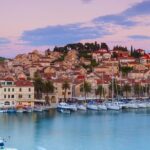
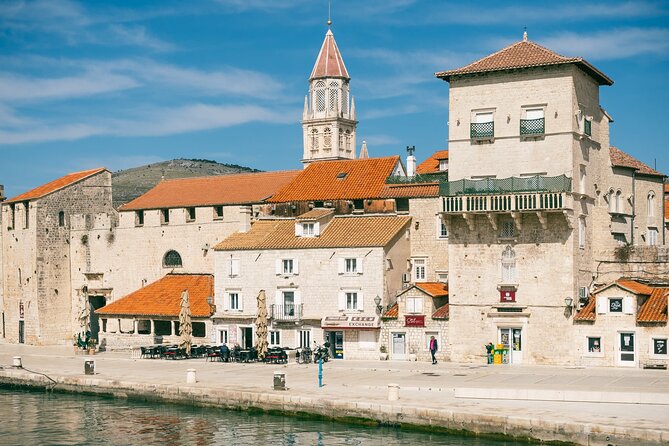
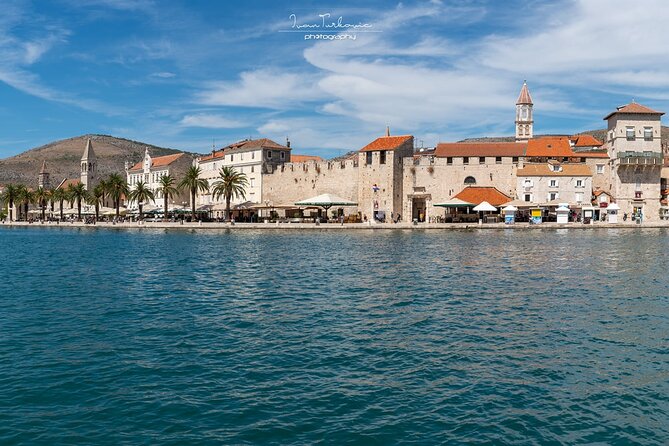
Once you shift to Trogir, you start at John Paul II Square (the central square of the old town). Trogir is known as a small Adriatic port city in central Dalmatia, and its old town is included on the UNESCO monuments list.
This is one of those places where UNESCO status isn’t just paperwork. The layout and building styles make it easy to understand why the designation matters. The tour points you toward key structures around the square, like the Loggia and the Clock Tower.
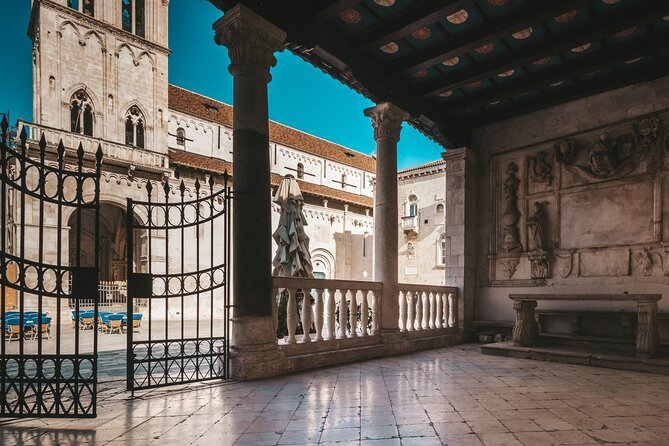
Your time here is short, so you’ll want to use the moment wisely. The itinerary notes the Loggia across from the cathedral, formerly a public courtroom, with six pillars decorated with capitals and reliefs on the wall. It also adds a practical seasonal reality: in summer, you may not clearly see the pillars because a coffee bar sits nearby. That’s exactly the kind of heads-up that helps you adjust your expectations and still enjoy the place.
One relief called the Relief of Justice by Nicholas Florentino is mentioned as visible. That’s the sort of specific detail a good guide can point out fast.
St Lawrence’s Cathedral: Romanesque-Gothic layers you can spot with the right guide
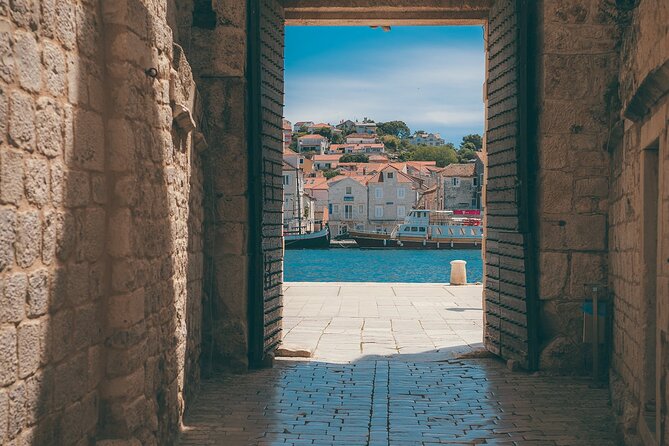
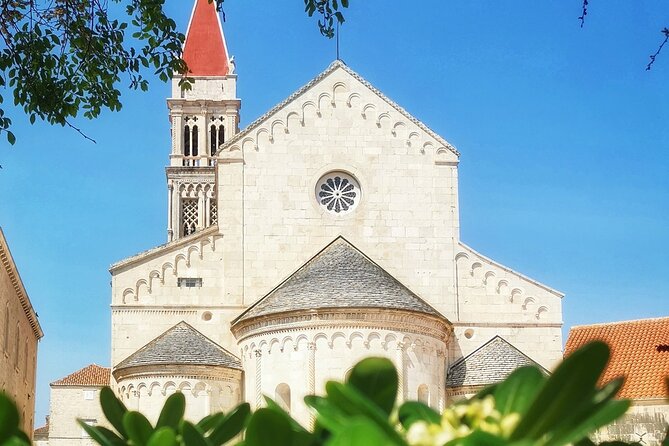
Next up is Saint Lawrence’s Cathedral (Katedrala Sv. Lovre), described as a Roman Catholic triple-naved basilica built in Romanesque-Gothic style. The build time stretched across several centuries, so you get multiple style periods in one building.
That multi-century construction is one reason this cathedral is worth your time. It isn’t just one style executed once. It’s a physical timeline. The itinerary also says it serves as the most imposing monument in Trogir, so even with limited time, you’ll feel the scale.
Admission ticket is listed as not included. So again, expect a separate fee if you want full interior access.
If you like churches that show their age through changes in style, you’ll probably enjoy this stop. If you only care about exteriors, you can still catch plenty of the impact from outside, but the cathedral is listed as a key “imposing monument” stop, so it makes more sense to plan for entry if it’s important to you.
Kamerlengo Fortress: best views for your time in Trogir
The tour then includes Kula Karmelengo (Kamerlengo Fortress), a 15th-century coastal fortress built during Venetian rule to protect Trogir from naval attacks. Today, it offers views over the old town, the marina, and nearby islands.
This is a classic travel trade-off: you get a viewpoint that gives you context for the whole city. From up there, the street layout, the harbor shape, and the island outlines start to snap into focus.
Admission is listed as not included, so factor that in if you want the full fortress experience rather than just the outside areas.
If you’re the type who likes photos but also wants to understand what you’re photographing, this is a great midpoint between the architecture stops and the smaller civic details later.
Town Loggia and Čipiko Palace: where civic life and power showed up
Back in the old town, the route includes the Town Loggia, described as the public meeting place for medieval Trogir. Important decisions were announced there, and legal matters were discussed. It reflects the city’s tradition of civic life and self-governance.
That might sound dry, but it’s actually a useful lens. When you stand near a public legal or civic space, the architecture reads differently. It’s not only about beauty. It’s about how people ran their community.
Next is Čipiko Palace, described as the largest residential palace in Trogir and an example of Gothic-Renaissance architecture. It belonged to the influential Čipiko family, showing the wealth and power of the noble past.
Admission ticket is listed as not included for this stop, so plan for a separate cost if interior access matters to you. If the goal is mainly to understand Trogir’s social hierarchy through buildings, you can still benefit from the quick exterior context provided by the guide.
Price and time: what $228.78 buys you (and what it doesn’t)
At $228.78 per person for about 6 hours, this isn’t a budget day-trip price. The value comes from three things your money supports.
First, it’s private, so you’re not sharing the guide with strangers. That matters on a tight schedule when timing and explanations have to fit your pace.
Second, this route covers both Split and Trogir highlights in one plan. If you were doing it alone, you’d still be paying for transportation and then spending extra time figuring out where to go next. This tour compresses the decision-making.
Third, the guide skill shows up in the flow. The reviews highlight that guides like Kristina add personal stories, and Andrea helps with navigating the crowds easily. Even without getting stuck in big lines, your day still improves when someone makes smart choices about what to see first.
What the price doesn’t buy: long linger time. The itinerary is structured for short visits, often around 15 minutes at the listed points. If you’re hoping for a slow, museum-like pace, you may feel rushed unless you plan to extend your stay on your own after the tour ends.
Also note that some admissions are listed as not included (including the Diocletian Palace substructures, St Lawrence’s Cathedral, the Kamerlengo Fortress, and Čipiko Palace). That can add cost, but at least the itinerary is clear about where extra tickets may apply.
Who this tour suits best (and who should choose something else)
This works well if you:
- want a private guide and a smooth plan across Split and Trogir
- like history but prefer clear explanations with good time management
- enjoy a mix of big monuments and specific “small but fun” stops like Grgur Ninski’s toe tradition
- don’t want to spend your day deciding between ten possible sites
It may not be ideal if you:
- plan to do a lot of inside-only time in churches and fortresses and need longer entry sessions
- strongly dislike separate admission fees and would rather pay only for one ticket
Should you book this VIP Split and Trogir tour?
If you’re visiting for a limited time and you want the headline sights without the mental load, I think this is a smart pick. The private format, English guide, pickup offered, and mobile ticketing reduce friction. And the itinerary’s mix of ticket-free highlights with optional paid stops means you can still manage your budget.
Book it sooner rather than later if your dates are fixed. This tour is booked far in advance on average, which usually means it fills up when people plan their Croatia days early.
If you love history, you’ll appreciate how the route connects Roman palace life to medieval civic Trogir. And if you love practical travel, you’ll appreciate the pace that keeps you moving, not wandering.
FAQ
How long is the tour?
The tour runs about 6 hours.
Is this tour private?
Yes. It is a private tour/activity, and only your group will participate.
Is pickup offered?
Pickup is offered.
Is the tour in English?
Yes, the tour is offered in English.
Are entrance tickets included?
Some stops are listed as free (for example, the Peristyle of Diocletian’s Palace and the Grgur Ninski statue). Other stops are listed as not included (including Diocletian Palace substructures, Saint Lawrence’s Cathedral, Kula Karmelengo, and Palace Cipiko). Central Square in Trogir and Town Loggia are listed as free.
Does the tour include a mobile ticket?
Yes, a mobile ticket is included.
Can I cancel and get a refund?
Free cancellation is available up to 24 hours in advance for a full refund.