REVIEW · SPLIT
Chill Private Walking Tour of Diocletian’s Palace
Book on Viator →Bookable on Viator
Roman walls are easier to read with a guide.
I like the private pacing and clear storytelling inside Diocletian’s Palace, from the Peristyle to the Golden Gate. I also love the way the guide uses 3D reconstructions to show what you’re seeing in today’s ruins against the palace’s look 17 centuries ago. One possible drawback: a few of the best interiors (like the cathedral and the Temple of Jupiter) are optional, so your exact total time and cost can shift depending on what you choose to enter.
This is a walk built for good weather and steady legs. If it’s pouring or too hot, you’ll want to follow your guide’s route plan and wear shoes you can trust on uneven stone.
In This Review
- Key highlights to look for
- Why a private walk through Diocletian’s Palace feels different
- Price and value: $107.84 per group, up to 15
- Meeting at the Eastern (Silver) Gate, then walking the palace the right way
- Stop 1: The Peristyle of Diocletian’s Palace (the palace’s core idea)
- Stops 2: Diocletian Palace substructures (seeing what’s usually out of sight)
- Stops 3 and 4: Cathedral of Saint Domnius and the Temple of Jupiter (Roman reuse, up close)
- Cathedral of Saint Domnius
- Temple of Jupiter
- Stop 5: Triklinij (a partial reconstruction that helps you imagine daily life)
- Stop 6: Papalićeva ulica (small alley, big clues)
- Stop 7: Fruit’s Square (Trg Brace Radic) (where the palace meets Croatia)
- Stop 8: The Golden Gate (fortifications and how they changed)
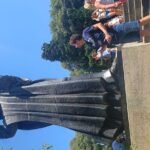
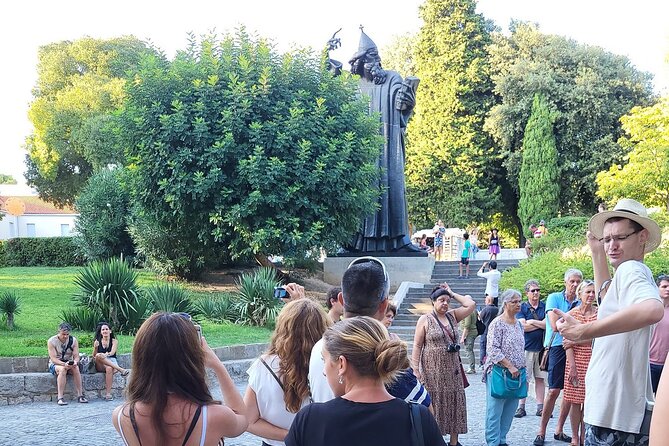
- Stop 9: Grgur Ninski Statue (ending with a Croatian thread)
- What I think is worth doing inside (and what you can safely skip)
- Timing, weather, and how to plan your day
- Who this tour is for (and who may want a different option)
- Should you book this tour?
- FAQ
- How long is the Chill Private Walking Tour of Diocletian’s Palace?
- How much does it cost, and is it per person?
- What language is the tour offered in?
- Is this a private tour?
- Are interior tickets included?
- What happens if the weather is bad or I need to cancel?
Key highlights to look for
- 3D reconstructions that help you picture the palace in Roman times
- A relaxed private group format (up to 15 people) with room for questions
- Roman-to-Christian transformations, especially at Saint Domnius and Jupiter’s Temple
- Architecture you can actually spot in the Peristyle, substructures, and Triklinij
- Split history beyond the Romans, ending with Grgur Ninski’s story
- Optional interior tickets for cathedral and museum parts of the palace substructures
Why a private walk through Diocletian’s Palace feels different
Diocletian’s Palace in Split is one of those places where you can wander for hours and still feel like you missed the point. This tour fixes that. You don’t just see famous stones—you learn how the palace worked, how the spaces connect, and why so many later layers were built right over (and into) Roman bones.
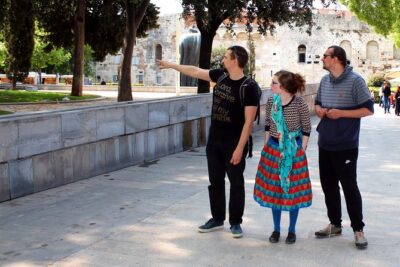
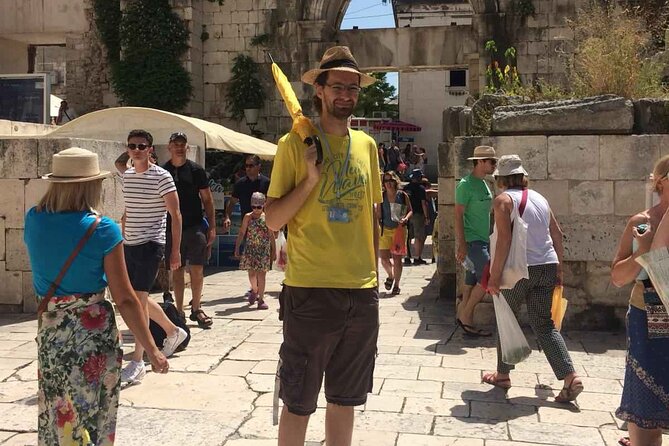
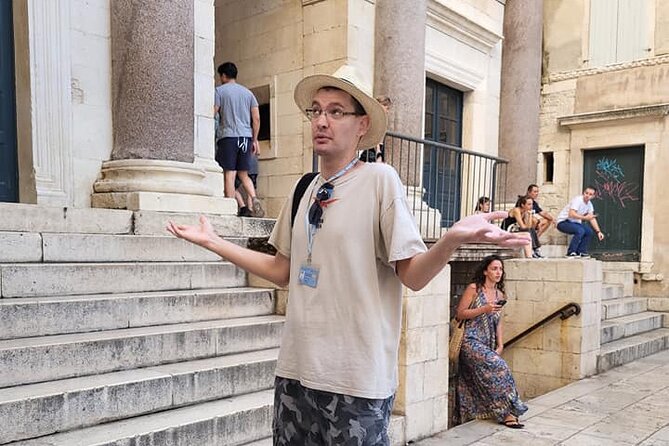
The private format matters more than it sounds. With a guide—rather than a crowd—you can stop for clarification. That’s where the palace clicks: how Diocletian’s rule shaped the architecture, how the later church changed the meaning of key spaces, and why certain areas are intact while others are mostly gone.
And the tone helps. The guide brings history down to street level, with practical explanations and light humor. In past tours, the guide (often identified as Mili) is also known for making useful cultural links, including Game of Thrones connections for fans who want that extra thread.
You can also read our reviews of more walking tours in Split

Price and value: $107.84 per group, up to 15
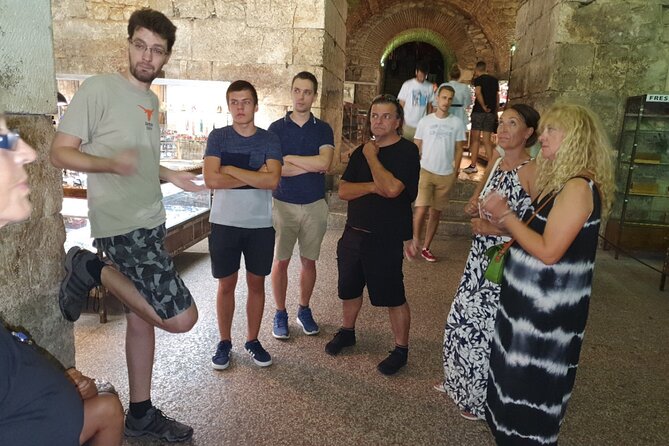
The price is $107.84 per group (up to 15 people). That’s an important detail for value, because it’s not priced per person. The bigger your group, the more it tends to feel like a bargain.
You can also think of what you’re paying for: a guide who can walk you through complicated layers of the same complex—Roman planning, Christian reuse, and Croatian historical context—plus the added help of 3D reconstructions. If you’re short on time in Split, this kind of focused guidance usually beats trying to self-sort the palace on your own.
If you’re traveling solo or as a couple, you’ll still likely find it worthwhile if you want the inside story and don’t want to spend your limited hours guessing what you’re looking at.
Meeting at the Eastern (Silver) Gate, then walking the palace the right way
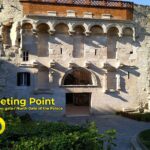
Your tour starts at the Eastern (Silver) Gate (Poljana kraljice Jelene 5, 21000 Split) and ends outside the northern gate area by the bronze statue of Grgur Ninski (Dioklecijanova 7 is listed near the Golden Gate end point).
The route makes sense because it moves you through the palace in a way that builds understanding. You begin with the palace’s public ceremonial core, then go into the architecture under and around it, and later shift toward later religious and Croatian historical layers. By the time you reach the Golden Gate area, you’re not just seeing another landmark—you’re assembling the palace into a single story.
Because it’s a private tour, you’ll get a walking pace that’s meant to work for your group. In at least one past tour, the guide was also flexible when weather hit hard, waiting out a thunderstorm and adjusting the route to avoid the worst of flooding. That kind of practical adaptability is exactly what you want on an outdoor, stone-heavy walk.
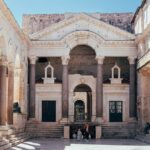
Stop 1: The Peristyle of Diocletian’s Palace (the palace’s core idea)
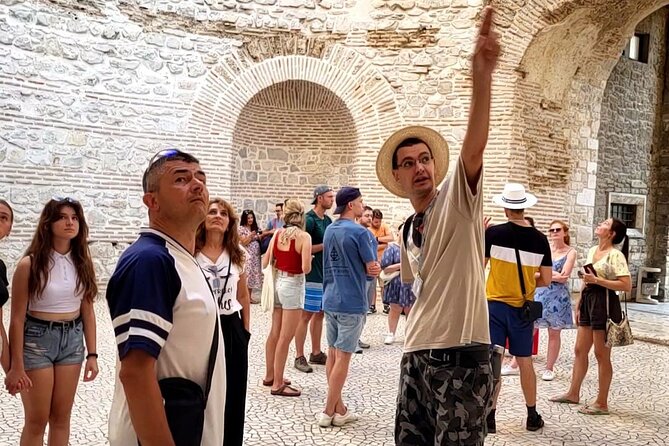
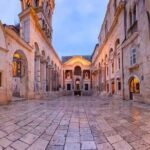
You’ll start at the Peristyle, the heart of Diocletian’s Palace. This is where the guide lays the foundation: who Diocletian was, why this palace existed, and how the design communicated power.
What I like about starting here is simple. The Peristyle gives you a visual anchor. After you understand what the center represents, it’s much easier to notice relationships between buildings later on—what’s meant to impress visitors, what’s meant for daily functions, and what’s meant for controlled movement.
Time-wise, plan about 20 minutes for this first stop. Also note that there’s no admission charge required for this part.
Stops 2: Diocletian Palace substructures (seeing what’s usually out of sight)
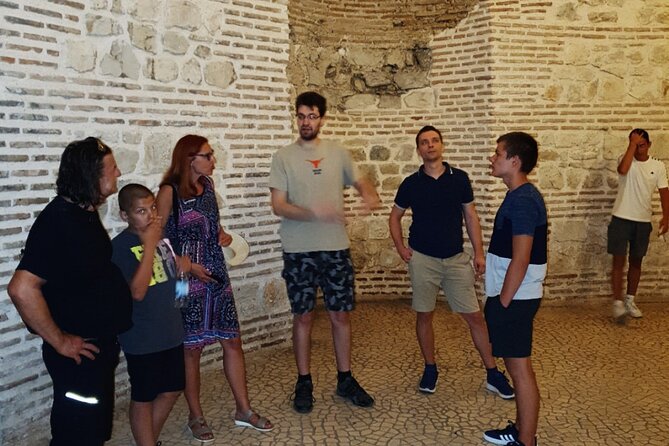
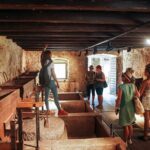
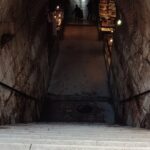
Next you’ll move through the free part of the palace substructures—the spaces under and around the palace’s main areas. This is one of the best ways to understand the palace as a working built environment rather than a set of photo stops.
If you want more, you can buy tickets to access the museum part of the substructures. That adds roughly 20 more minutes and gives you a deeper look at architecture and history. If you’re on a tight schedule, you can stick to the free section and still leave with the big picture.
This stop has a small tradeoff. The optional interior portion can add time and involves extra cost, so you’ll want to decide early based on your interests. If you love how buildings are put together, it’s a strong add-on. If you prefer to keep momentum through the palace’s highlights, the free portion may be enough.
You can also read our reviews of more private tours in Split





Stops 3 and 4: Cathedral of Saint Domnius and the Temple of Jupiter (Roman reuse, up close)
Then the tour shifts from palace engineering to religious transformation.
Cathedral of Saint Domnius
At the Cathedral of Saint Domnius, you’ll learn why it’s considered one of the best preserved Roman structures built as part of Diocletian’s Palace. The guide also explains the key idea: you’re looking at how a Roman tomb environment was converted into a Christian cathedral.
This is where the palace becomes more than archaeology. The building isn’t just old—it shows how later cultures repurposed earlier sacred spaces.
You’ll spend about 10 minutes here without entering. If you have a cathedral ticket, you’ll go inside and add about 10 minutes.
Temple of Jupiter
Next comes the Temple of Jupiter, another remarkably preserved Roman structure. You’ll hear about Jupiter as a chief deity and, again, the church’s later repurposing of the space.
Just like Saint Domnius, the exterior tells plenty, and the interior visit is optional. If you skip interiors, you still get the architectural meaning; if you enter, you get more context and a fuller feel for how the space changed.
Stop 5: Triklinij (a partial reconstruction that helps you imagine daily life)
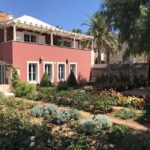
The Triklinij is in the south eastern corner of the palace and is mostly destroyed today. The twist is that it includes a partial reconstruction, designed to give you an impression of how Diocletian might have lived there.
This stop is valuable because it shifts you from major monuments to something closer to lived experience. You start thinking about routine and comfort, not just ceremonies and fortifications.
Expect about 15 minutes here, and yes—you’re seeing a reconstructed viewpoint. That matters: you’re not looking at a perfectly preserved original, so your guide’s explanation (and the recon details they bring in) is key to reading the room in your mind.
Stop 6: Papalićeva ulica (small alley, big clues)
A short walk brings you through Papalićeva ulica, an alleyway in the north half of the palace where the guide shares facts that help you understand how this space functioned and how people moved.
This is the kind of stop that can feel minor if you’re rushing, but it often ends up being the glue between the grand sites. Alleys and connections show you the human scale of the palace layout. They also show how the complex fits into today’s streets.
Time here is about 15 minutes.
Stop 7: Fruit’s Square (Trg Brace Radic) (where the palace meets Croatia)
Next is Fruit’s Square (Trg Brace Radic), outside the palace. This stop does something important: it connects Roman Split to later Croatian history.
You’ll see how Diocletian’s Palace was integrated into newer buildings—and how it still exists in that mixed, layered state today. That integration is the real story of Split. It’s not a sealed Roman museum. It’s an active urban space where old structures became part of newer life.
Plan 15 minutes here.
Stop 8: The Golden Gate (fortifications and how they changed)
Approaching the end, you’ll see the Golden Gate, the northern gate of the palace. This is a practical architecture lesson: fortifications, entrances, and how those features changed from original construction to what exists now.
This stop is shorter, about 10 minutes, but it ties together earlier themes. Once you understand where people entered and how movement was controlled, the palace stops being a jumble of walls and starts looking like a system.
Stop 9: Grgur Ninski Statue (ending with a Croatian thread)
The final stop is outside the northern gate by the bronze statue of Grgur Ninski. The guide uses this moment to consolidate what you learned about Roman construction and then wrap up the broader arc of Croatia’s history so far.
It’s a smart closing. You leave with a memory anchor in a public square (not just inside ruins), and you’re reminded that Diocletian’s Palace isn’t the end of the story—it’s part of the longer one.
Time for this last stretch is about 15 minutes.
What I think is worth doing inside (and what you can safely skip)
This tour has optional interior parts. Here’s how to decide without overthinking it:
- If you love architecture and want maximum context, consider adding the substructures museum part, plus entering Saint Domnius and the Temple of Jupiter.
- If you prefer a steady outdoor walk and shorter total time, you can stay with the free exterior sections and still get the main storyline.
- If you’re doing this early in your Split trip, interiors can help you understand what you’ll see the rest of the day. If you’re doing it late, you can skip interiors and still leave with the palace explained.
Because the stated duration is about 1 hour 30 minutes to 2 hours, your choices matter. The interiors typically add time in the neighborhood of 10 minutes each for the cathedral and Jupiter, plus about 20 for the substructures museum part.
Timing, weather, and how to plan your day
The tour is a walking experience inside an active historic zone. The experience information also flags that it needs good weather. That makes sense: you’re on uneven stone, and heavy rain can slow the route.
A practical tip: when the weather is warm, going in the cooler part of the day can help your energy. In past tours, a guide suggested this kind of timing for warm days, and it’s an easy adjustment to make once you’re there.
Also plan around the fact that this is a mobile ticket experience and your guide will manage the flow. You’ll still want to keep your schedule flexible, especially if you’re pairing the tour with other sights across Split.
Who this tour is for (and who may want a different option)
I’d point you toward this private walking tour if:
- you want the palace explained in a clear way, not just photographed
- you like seeing how one culture’s spaces get reused by the next
- you’re traveling with family or a small group and want a shared experience with room for questions
- you’re short on time and want the palace story in about 2 hours
This might feel less ideal if:
- you only want outside sights and don’t care about interior changes or the palace’s deeper structure
- you have no flexibility for weather, since it’s designed as a walking route and the experience requires decent conditions
Should you book this tour?
Yes, if you want Diocletian’s Palace to make sense fast. For the money, you’re not paying for a long list of stops—you’re paying for a guide who can connect the stones to the story, plus 3D reconstructions that help your brain “see” the palace as it once was.
Book it especially if you enjoy layered history: Roman rule, Christian reuse, then later Croatian threads through the same spaces. If you’re willing to choose one or two optional interiors, you’ll get an even better payoff from your time in Split.
FAQ
How long is the Chill Private Walking Tour of Diocletian’s Palace?
It lasts about 1 hour 30 minutes to 2 hours (the exact time can grow if you choose optional interior visits).
How much does it cost, and is it per person?
The price is $107.84 per group (up to 15 people), so the cost is shared by your group rather than per person.
What language is the tour offered in?
The tour is offered in English.
Is this a private tour?
Yes. This is a private tour/activity, meaning only your group participates.
Are interior tickets included?
Some interiors have optional fees. You can visit the museum part of the substructures, go inside the Cathedral of Saint Domnius, and visit the small interior of the Temple of Jupiter if you have tickets.
What happens if the weather is bad or I need to cancel?
The experience requires good weather. If it’s canceled due to poor weather, you’ll be offered a different date or a full refund. You can also cancel for a full refund if you cancel at least 24 hours in advance.