REVIEW · SPLIT
Walking Tour of Split with a ‘Magister’ of History
Book on Viator →Operated by DiocleSpot Tours · Bookable on Viator
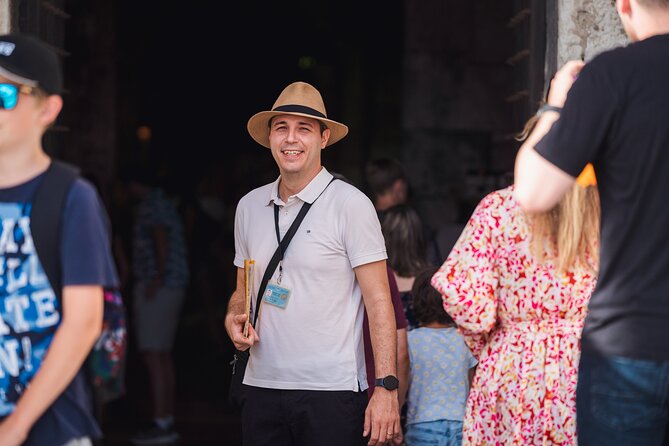
Roman ruins, still working streets, one smart walk. This walking tour is led by Toni Šare, owner of DiocleSpot Tours, and it focuses on what you’re actually seeing—Roman walls, medieval reuse, and the later layers that shaped today’s Split. Two things I really liked: the 3D reconstructions that clarify what the Palace looked like in its heyday, and the way the walk links big monuments to small, telling details you’d normally skip.
One possible drawback: you’re not going inside major paid sights or museums. So if your dream day is climbing bell towers, stepping into interiors, or spending extra time in galleries, this may feel more like a sharp orientation plus storytelling than a ticket-and-take-your-time visit.
In This Review
- Key highlights worth planning around
- Walking the Palace Like a Local, Not a Checklist
- Starting at Brass Gate (Porta Aenea): The Waterfront-First Perspective
- Peristyle Square: Where Roman Space Still Shapes the City
- Cathedral of Saint Domnius: Mausoleum to Cathedral (Without Going In)
- Temple of Jupiter and the Art of Looking Carefully
- Eastern (Silver) Gate Views: The Palace Opens Like a Frame
- Grgur Ninski and the Vestibulum: Language, Faith, and Private Space
- Golden Gate and the Northern Wall: Roman Defense Meets Medieval Survival
- Ending at Old Town Hall (Narodni trg): A Smart Finish with Easy Next Steps
- Price and Time: Why $34.83 Can Be Good Value
- Who This Tour Fits Best (And Who Might Want Something Else)
- Should You Book This Walk in Split?
- FAQ
- How long is the Walking Tour of Split with a Magister of History?
- Is the tour offered in English?
- What’s included, and what isn’t?
- Where do we meet and where does it end?
- What is the maximum group size?
- What if the weather is bad?
- Can I bring a service animal, and is it suitable for most people?
Key highlights worth planning around
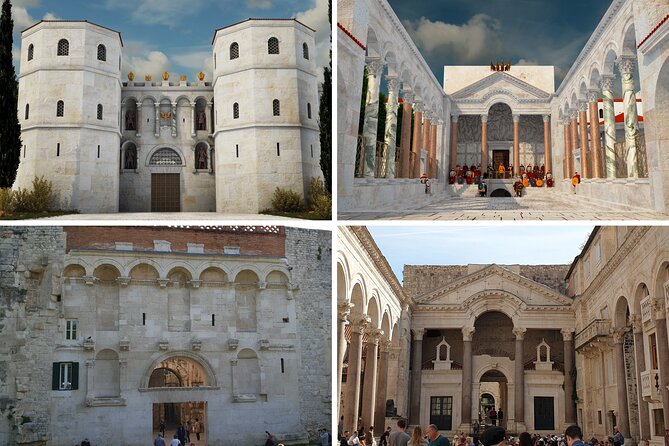
- Toni Šare’s 3D reconstructions help you visualize Roman decoration and lost building parts
- No museum hopping: you’ll stay focused on outdoor architecture and city fabric
- Small group size (up to 18) makes it easier to ask questions and get direct answers
- Iconic Palace entrances from Brass Gate to Golden Gate, plus the Cathedral and Jupiter Temple explained from the outside
- Local culture moments, including the occasional timing of live traditional singing
Walking the Palace Like a Local, Not a Checklist
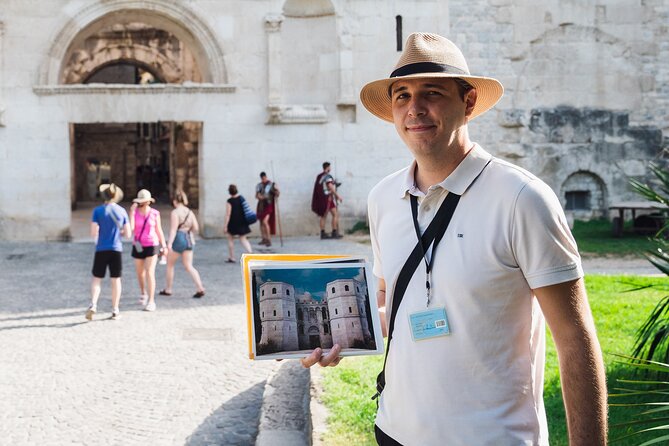
Split can feel like two cities stacked on each other. You walk ten steps and you’re in Roman stone; you turn again and you’re in medieval streets; a little later, you’re back to a living coastal town with daily routines all around you. What makes this tour stand out is that Toni doesn’t treat history like a museum label. He treats it like a map—something you can read while you walk.
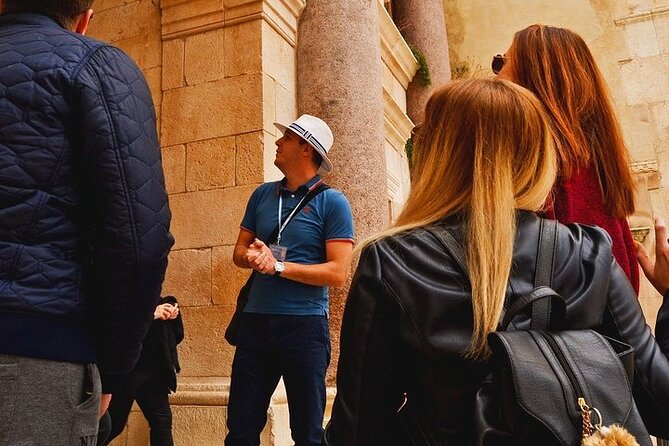
The guide’s background matters. Toni is from Split and has studied and taught history, and it shows in how he explains cause and effect: why Diocletian’s Palace became the city’s shell, how later communities adapted it, and what changed versus what stayed surprisingly intact. You also get humour, and that keeps the walk from turning into a lecture.
You’ll cover a lot in about 1 hour 40 minutes to 1 hour 50 minutes, so wear good shoes and don’t plan to eat a full lunch before you go. The route is built to keep moving, with frequent stops that slow you down just enough to notice stonework, alignments, and design choices.
You can also read our reviews of more walking tours in Split

Starting at Brass Gate (Porta Aenea): The Waterfront-First Perspective
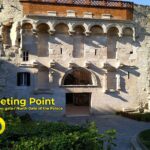
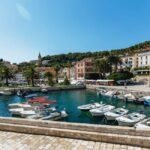
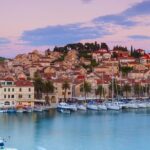
The tour starts at Brass Gate (Porta Aenea) by the waterfront (Obala Hrvatskog narodnog preporoda 22). This spot is perfect because it frames the whole Palace from the outside. Instead of starting with the most famous courtyard, you begin where locals connect to the city—along Riva Harbor, Split’s Riviera.
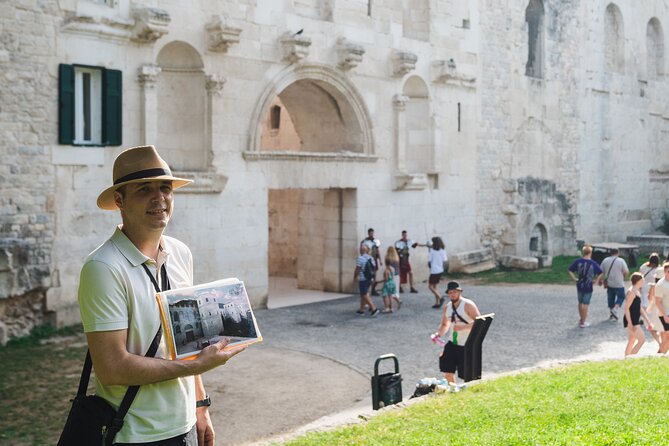
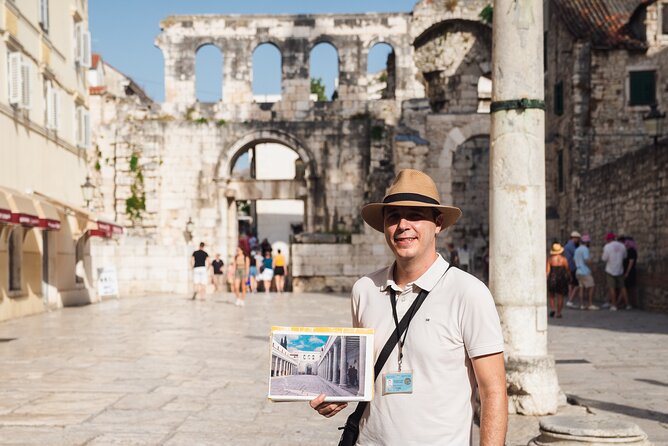
At the opening, Toni uses small visual aids—graphic and model representations—to set you up for what you’ll see inside the Palace. Then you get a clear sightline to the southern wall of Diocletian’s Palace, which is one of those details that only clicks once you’ve stood in the right place. If you’ve ever wondered why this place feels so strong and defensive, that wall gives you the answer early.
A practical note: harbors can be windy and bright, and this first stretch works best if you’re ready to look up. Bring sunglasses if you need them, and don’t assume shade will save you before the tour moves inland.
Peristyle Square: Where Roman Space Still Shapes the City
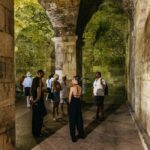
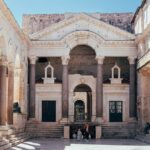
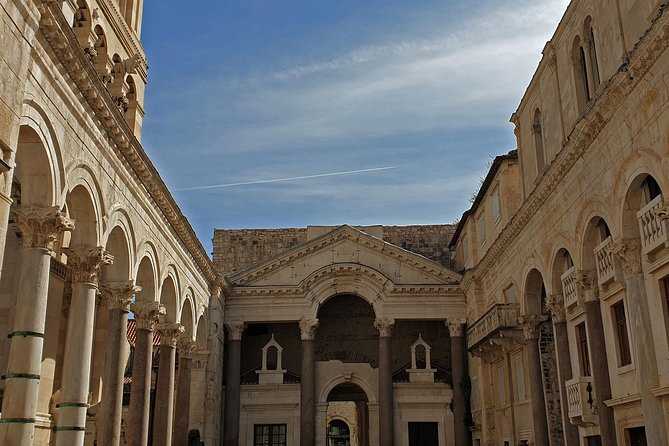
Next comes the Peristyle of Diocletian’s Palace, the central square that’s still one of the most important open spaces in Split. This is the part where many visitors take a quick photo and move on. Toni turns it into a lesson about proportion and power—how Roman architecture created a stage for daily life in the Palace.
You’ll also get Toni’s 3D reconstructions here. That’s not a gimmick. It helps you understand what “preserved” really means in a place like this. Some elements survive in original form; others are missing; others were altered so completely that they look new even when they’re sitting on Roman bones. Toni’s approach makes those differences easier to spot.
The time here is short, but it’s enough to learn what to look for: alignments, the rhythm of openings, and the ways later changes respected the original structure instead of starting over. If you like architecture and you want your photos to be smarter, this is where the tour pays off.
Cathedral of Saint Domnius: Mausoleum to Cathedral (Without Going In)
The tour then focuses on Cathedral of Saint Domnius (the Mausoleum of Diocletian)—one of the best-preserved Roman structures in Split and still in use today. Even though you won’t enter the inside, you’ll learn what matters: how the Christian community converted a Roman grave site into a cathedral and how that change affected the building’s function and symbolism.
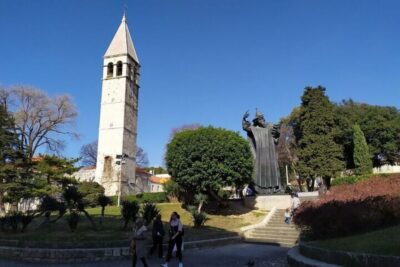
Toni also explains the bell tower and the relationship between the religious life that continued here and the Roman structure that made it possible. This is one of those moments where staying outside doesn’t feel like a compromise. From outside, you can still see the massing and key Roman features—and you can understand the transformation without waiting in any interior lines.
If you want deep interior views, plan a separate visit later. But as an orientation to why this building is so important, the outside stop works well.
Temple of Jupiter and the Art of Looking Carefully
After the cathedral, you’ll stand at the Temple of Jupiter, described as one of the best-preserved late-Roman temples in the world. Here’s the twist Toni highlights: he points out oddities and what he calls anomalies and mistakes Romans made during construction.
That might sound like trivia, but it’s actually the point. History isn’t just monuments in perfect condition. It’s humans building on deadlines and with imperfect knowledge. When you notice the small irregularities, the temple becomes more real—and you start seeing similar “evidence of work” in other parts of the Palace.
You won’t go inside this temple, so don’t expect an interior viewpoint. Still, you’ll learn how to read the outside so it stops looking like just a label on a wall.
You can also read our reviews of more historical tours in Split


Eastern (Silver) Gate Views: The Palace Opens Like a Frame
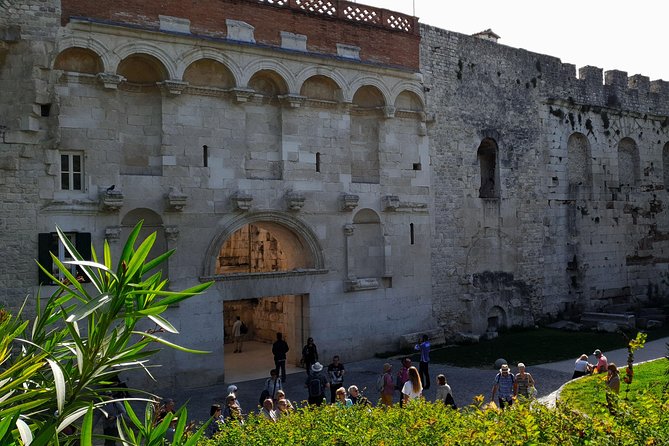
The Eastern (Silver Gate), along with the surrounding viewpoints, is where the tour rewards your patience with a classic Split postcard view—except you’ll know what you’re looking at. From here, you get a balanced sightline featuring the Cathedral (Mausoleum) on one side, the Silver Gate on the other, and beneath you the preserved trace of the original road.
That “road under the view” detail is important because it shows how the modern city sits on top of Roman movement. You’re not just seeing an entrance. You’re seeing infrastructure—how people passed through and how the city’s circulation evolved.
This stop is brief, but it’s also a good reset point. If you’ve been squinting at architectural details, this view gives your eyes a rest while still feeding you useful context.
Grgur Ninski and the Vestibulum: Language, Faith, and Private Space
Next up is Grgur Ninski—the statue that dominates the square and instantly anchors people’s sense of place in Split. Toni explains what the figure represents and why it matters for Croatian language and early medieval culture. Even if you know a little Croatian history, this kind of on-street explanation makes it easier to connect the statue to real cultural identity, not just stone artwork.
A few steps later, you’ll reach the Vestibulum—the ancient entrance to Diocletian’s private residence. This stop shifts the mood. You go from public space into the idea of private power: the spaces that belonged to the emperor rather than the everyday city.
Toni takes you around the remains tied to Diocletian’s private residence, and the value here is understanding hierarchy in architecture. Who got access? Where did movement slow down? Where did you transition from public authority to controlled, protected space? It’s a great way to understand the Palace as a system, not just a pile of ruins.
Golden Gate and the Northern Wall: Roman Defense Meets Medieval Survival
The most memorable entrance on the route is the Golden Gate, the main entrance to the Palace. It’s described as the best-preserved of the four entrances, with the most decoration and a strong sense of drama. Toni uses this spot to show you how the northern wall still tells the story of Roman defense.
This is also where you get a clear lesson in survival and adaptation. Toni explains how medieval communities kept using the Roman-made structures for defense, and how they removed what they didn’t need. It’s the opposite of a clean museum story. It’s a living city reusing hard materials because that’s what made sense.
As you continue through the Palace complex area, you’ll also see palaces of noble families and get the story behind them. One of the more interesting add-ons, if your group is into it, is the Game of Thrones angle—Toni can point out filming locations around Split and you may even pass the related fan shop area.
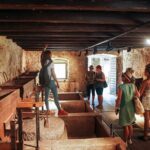
Near the end of the run, the tour also touches the City Museum of Split, located in a Renaissance noble palace. You won’t enter the museum itself, but you’ll see the courtyard from outside. This is the right compromise: you get the Renaissance setting and then Toni connects it to Venetian influence, explaining how these palace styles took root later.
Ending at Old Town Hall (Narodni trg): A Smart Finish with Easy Next Steps
The walk closes at Narodni trg—Piazza square, also called Pjaca—near the Old Town Hall area. This ending point works because it’s practical: once you’re done learning, you’re in the city’s most natural crossroads where it’s easiest to choose what comes next.
From the square, you can reach other sights without feeling like you’re doubling back. Toni also highlights the 14th-century Town Hall and other structures around the square, giving you a final set of details to notice even after the tour is over.
This is a good place to catch your breath, check your bearings, and then decide whether you want to return to the Palace areas you liked most or branch out toward cafés and side streets.
Price and Time: Why $34.83 Can Be Good Value
At $34.83 per person, the biggest question is what you get for the money. You’re paying for a guide who can explain what you see, not just recite dates. You’re also getting 3D reconstructions at key points, which helps you turn ruins into something readable.
The tour is also timed for value in a short window—about 1 hour 40 to 1 hour 50 minutes—so it fits neatly into most first-day plans. If you’re visiting for a limited number of hours and you want a solid starting framework, this can save time later. You won’t bounce between multiple paid entries, and you won’t spend your day locked into slow museum pacing.
One more value factor: group size. With a maximum of 18 travelers, it’s easier to ask questions without losing your place. That matters a lot on history tours, because the best moments often come from your own curiosity—what changed, why it changed, and how it affected ordinary life.
Who This Tour Fits Best (And Who Might Want Something Else)
This tour is ideal if you like seeing how places work. You’ll enjoy it if you’re the type who looks for alignments, entrance points, reused stone, and the logic behind layout. It’s also a great way to build confidence in Split fast. After you finish, you’ll know how the Palace ties into the rest of the old town.
You might prefer a different kind of tour if you want lots of inside time—especially if you’re hoping to enter buildings and spend long stretches in interiors. This walk is built to stay outside and read architecture at street level.
It’s also a good pick for hot days or the end of the afternoon, since an evening schedule can help you avoid peak heat (one guest specifically noted that timing helped). Just note you still do a lot of outdoor walking, so plan for comfort.
Should You Book This Walk in Split?
Yes—if you want a high-signal introduction to Split that makes the Roman core make sense right away. I’d book it early in your trip if you can, because the context sticks and improves how you view everything else you do afterward.
I’d pass or pair it with an interior-focused visit if your priority is paid sites inside and museum time. Think of this as your architect’s-eye and storyteller’s-roadmap. Then, if you find a particular building that grabs you, you can return on your own and go deeper where you want.
If you’re coming on a day with good weather and you’re ready to walk and look up, you’ll get a lot out of this one.
FAQ
How long is the Walking Tour of Split with a Magister of History?
The tour runs about 1 hour 40 minutes to 1 hour 50 minutes.
Is the tour offered in English?
Yes, the tour is offered in English.
What’s included, and what isn’t?
You get a guided walk with 3D reconstructions, led by Toni Šare. The tour does not include entering museums or paid sites.
Where do we meet and where does it end?
You meet at Brass Gate (Porta Aenea), Obala Hrvatskog narodnog preporoda 22, Split and end at Narodni trg (Pjaca), Split.
What is the maximum group size?
The group is capped at 18 travelers.
What if the weather is bad?
This experience requires good weather. If it’s canceled due to poor weather, you’ll be offered a different date or a full refund.
Can I bring a service animal, and is it suitable for most people?
Service animals are allowed, and most travelers can participate. It’s also near public transportation.
If you want, tell me your dates and whether you prefer morning or evening, and I’ll suggest the best way to pair this with 1-2 specific follow-up stops in Split.