REVIEW · SPLIT
Private Split Walking tour with a Photo session
Book on Viator →Operated by Costumed Tours · Bookable on Viator
Split hits different when someone aims a lens.
This private walking tour pairs a live guide with a private lifestyle photographer (Ivan Gudić), so you’re not just looking at Diocletian-era Split—you’re capturing it. You’ll cover key spots from the Riva promenade to the Prokurative area in about 2.5 hours, then the rest of the day is yours.
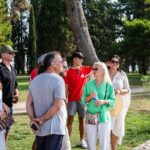
I love how easy the meeting spot is to find, starting at Obala Hrvatskog narodnog preporoda in central Split near the bronze model of the city. I also like the flexibility: it’s private, so you can slow down for photos and questions instead of getting swept along. The guide Jelena is especially praised for being punctual, easy to follow in English, and good at making Roman stories feel real (not like a textbook).
The main thing to consider is cost. At $300.73 per person, this is best when you really want the photo component and a one-on-one pace, not just a quick walk through the old town. It also runs outdoors and depends on good weather, so plan backup options for rain.
In This Review
- Key things to know before you go
- What the private photo session really adds in Split
- Price and what you actually get for $300.73 per person
- Meeting at Obala Hrvatskog narodnog preporoda: easy to locate, central to everything
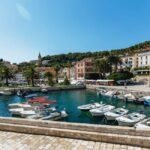
- Riva Harbor promenade: Split’s waterfront living room
- Diocletian Palace: Roman planning you can still read today
- Vestibulum and the Cathedral’s quiet acoustics cousin
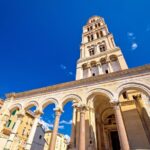
- Saint Domnius Cathedral: when pagan Rome becomes Christian Split
- Gregory of Nin outside the Golden Gate: wish-making with a sculpted toe
- People’s Square (Pjaca) and Fruit’s Square: Split’s street life has a past
- Pjaca (People’s Square / Narodni Trg)
- Fruit’s Square (Trg Brace Radic)
- Prokurative and Republic Square: Venetian-style arches in Dalmatia
- How the 2.5-hour format helps you enjoy the rest of the day
- Should you book this Split walking + photo tour?
- FAQ
- How long is the private Split walking tour with the photo session?
- Where does the tour start and end?
- What language is the tour offered in?
- Who provides the photography during the tour?
- Are any admissions required during the walk?
- Is the tour private?
- What if the weather is bad or you need to cancel?
Key things to know before you go
- Private photo session with Ivan Gudić: you’ll get professional lifestyle shots as you walk through Split’s standout landmarks.
- Get oriented fast in 2.5 hours: the route links Riva, Diocletian Palace highlights, and the squares around town.
- Old-town scenes with built-in photo stops: Roman gates, the Vestibulum acoustics, Saint Domnius details, and more.
- You control the pace: private format means you can pause for better angles without feeling rushed.
- Weather matters: the experience notes good weather is required, so keep an eye on conditions.
- Small extra cost may apply for the Cathedral complex: budget around 25 KN / 3.5 euros unless your option covers it.
What the private photo session really adds in Split
Split’s center can feel like sensory overload in the best way—stone, sun, sea air, and crowds—but a standard group tour often means “look fast, move on.” Here, the photographer angle changes that. Instead of racing from stop to stop, you get a reason to slow down at the exact moments where the light and stonework do their best work.
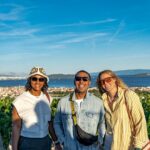
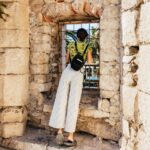
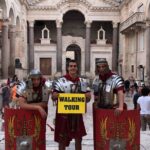
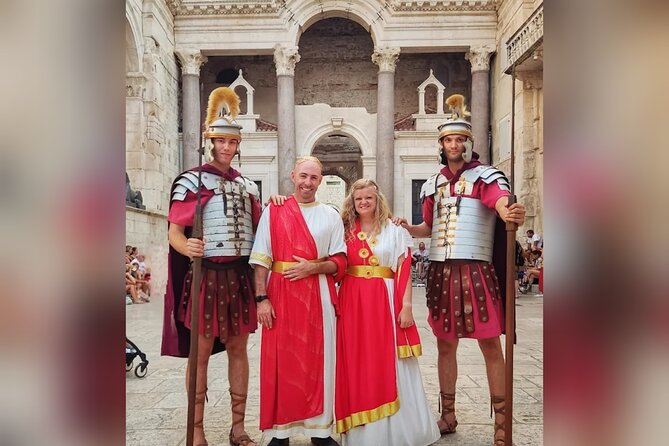
The photo element is handled by Ivan Gudić, listed as the included professional lifestyle photographer. In practice, that means you’re thinking about composition while your guide handles storytelling. One of the most fun parts is that the photo time isn’t just plain standing-and-smiling; you may be offered a playful Roman-themed costume photo moment at the end to match the Diocletian narrative.
If you care about photos that look like your trip (not like a phone snapshot from 10 feet away), this structure makes sense. And if you don’t care much about photos, the private pacing still helps you get the landmarks in context without feeling rushed.
You can also read our reviews of more walking tours in Split
Price and what you actually get for $300.73 per person
Let’s be blunt: $300.73 per person is not “cheap.” For that money, you’re paying for a private format plus a pro photographer, not just a walking guide. So the value depends on your travel style.
This tour can feel like a great deal if any of these are true:
- You’re short on time and want a high-impact orientation route in about 2.5 hours.
- You want a photo record of Split’s key Roman-era details.
- You prefer a one-to-one (or small, private) pace where you can ask questions and move slower.
It may feel overpriced if your goal is simply to see the palace walls and squares on the cheapest possible budget. For budget-first travelers, Split is one of those cities where you can DIY a lot—especially around the Diocletian core. But this tour’s differentiator is the photo session plus the guided thread that ties everything together.
One more money note: Saint Domnius (and connected areas like the Temple of Jupiter and the Crypt of St. Lucy) is listed as costing 25 KN / about 3.5 euros. In the stop details, it also appears as included, so don’t assume. I’d treat it as a small add-on and confirm before you go.
Meeting at Obala Hrvatskog narodnog preporoda: easy to locate, central to everything
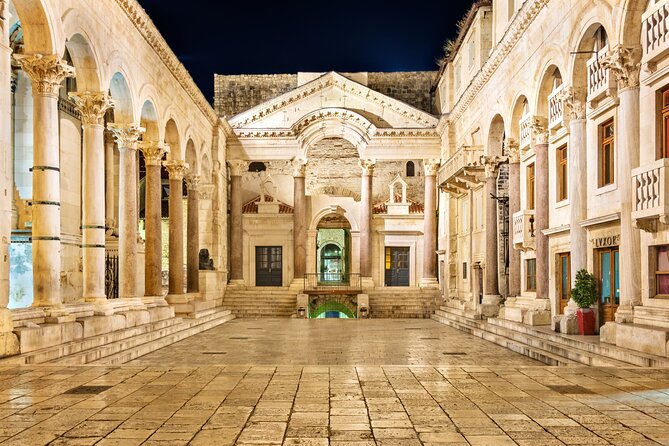
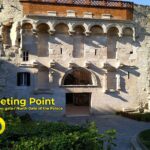
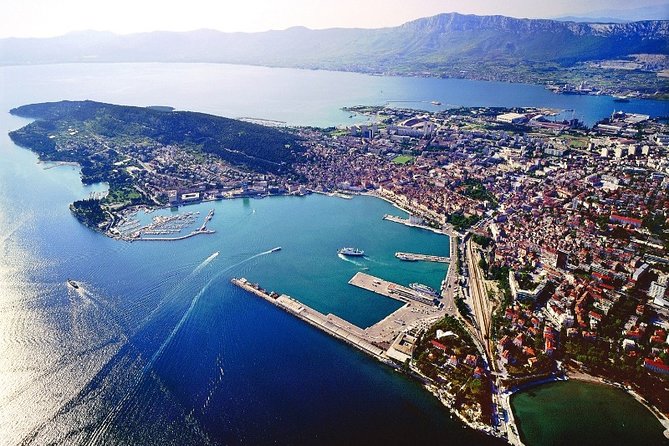
Your tour starts at Obala Hrvatskog narodnog preporoda, 21000, Split. This is a smart start because it puts you at the city’s front porch—the sea promenade where locals actually spend time.
The experience is set up to be easy to find, beginning near the bronze model of Split at the very start of the Riva promenade. That matters. If you’ve ever shown up to a “meeting point” that’s basically a vague guess, you know why this is important.
It also helps that the start is near public transportation. So whether you’re arriving from a cruise stop, your hotel, or walking over from the old center, it’s not a hassle to get there.
Riva Harbor promenade: Split’s waterfront living room
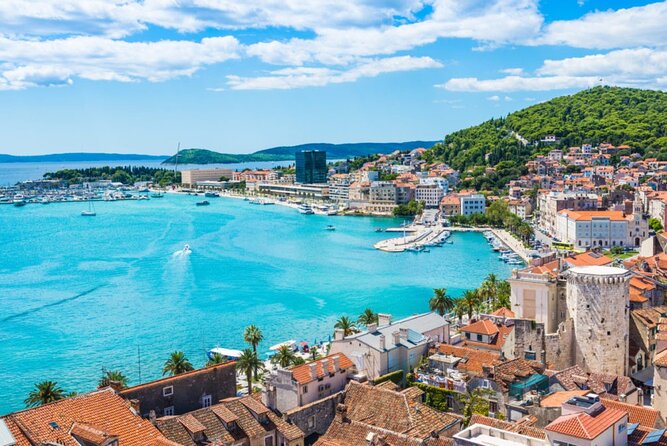
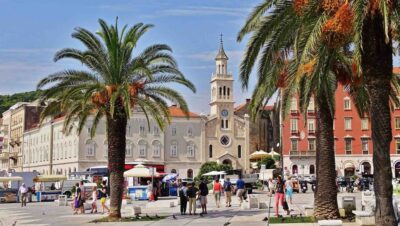
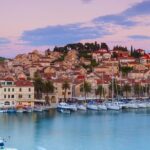
You’ll begin on the Riva promenade, described as Split’s most important public space. It’s not just a pretty stretch of sea view—it’s where the city gathers, especially around seasonal celebrations and big local events.
This part of the walk is about perspective. From here, you understand why Split feels “alive” even when the tour moves slowly: the sea is right there, restaurants and coffee spots line the edges, and the promenade acts like an open-air stage for the city’s rhythm.
Expect a short stop—around 10 minutes—to get your bearings and start the story right. If you want a first photo that looks like Split in one frame, this is a good place to ask the photographer for an early composition before you head deeper into the stone maze.
Diocletian Palace: Roman planning you can still read today

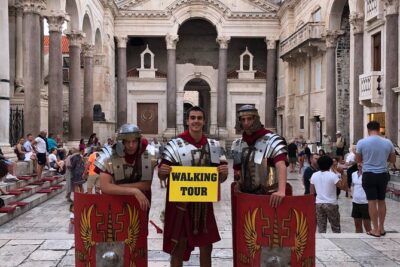
Next up is the Palazzo di Diocleziano, one of the best preserved Roman architecture complexes. The guide’s framing here matters: the palace isn’t just “a ruin.” It was built like a hybrid—part luxury villa (a summer house), part military camp.
You’ll hear it described as divided into four parts with two main streets, and that the south side connects to the emperor’s apartment and ceremonial life, while the north side handled military and practical functions like storage and servants. This is the kind of explanation that turns walls into a map.
Stop time is about 30 minutes, which is enough to walk a chunk of the area and still absorb details without feeling rushed. If you love Roman design, focus on how the palace works as geometry. If you’re less into architecture, this is still worth it because the palace layout explains why Split’s streets behave the way they do.
You can also read our reviews of more private tours in Split

Vestibulum and the Cathedral’s quiet acoustics cousin

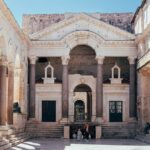
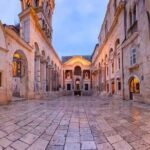
After the palace, you move into the Vestibulum of Diocletian’s Palace. From the outside it’s rectangular; inside, it shifts into a circular ground plan, which sounds academic but actually feels dramatic when you’re standing there.
Here’s what’s worth paying attention to:
- Semicircular niches and statues (even if you’re just glimpsing them while walking).
- A large cupola with colorful mosaic.
- The striking whiteness of the round wall.
There’s also a fascinating human angle: the vestibule wasn’t always sacred or purely ceremonial. It was used for living not that long ago—people kept poultry there and cultivated gardens. It’s a reminder that historic spaces are not always museum quiet.
Stop time is around 10 minutes, but the standout detail is the acoustic reputation. The experience notes that groups can sing traditional Dalmatian a capella songs here, and when that happens, the space becomes its own instrument. Even if singing isn’t happening during your visit, you’ll still notice why people associate this place with sound.
Saint Domnius Cathedral: when pagan Rome becomes Christian Split

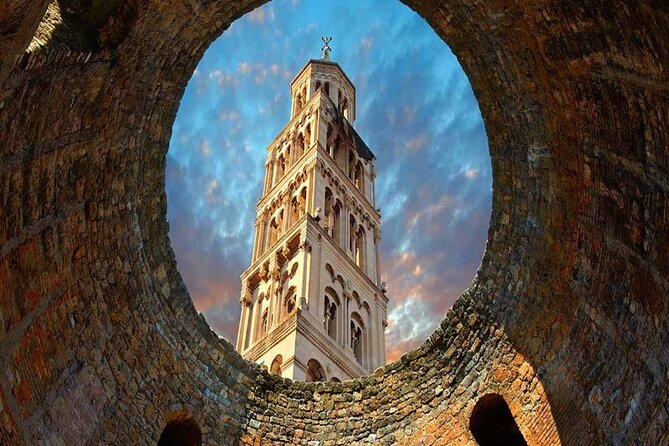
Then you’ll reach Cathedral of Saint Domnius, which is built on the older Mausoleum of Emperor Diocletian. The concept is simple but powerful: you’re literally in a site where ancient pagan imperial power becomes Christian continuity.
The tour framing highlights the layered timeline:
- Mausoleum beginnings under Diocletian’s era.
- Conversion into a cathedral by the 7th century.
- Relics taking a major role, including St. Domnius and St. Anastasius (martyrs linked to nearby Solin).
This is also a place of living tradition. The guide points to the way history shows up through liturgy, processions, and St. Domnius day celebrations tied to Split’s patron saint.
Practically, expect about 15 minutes here. Entry for the cathedral complex is listed as 25 KN / around 3.5 euros, covering the Cathedral plus the Temple of Jupiter and the Crypt of St. Lucy. Again, confirm your exact option, but budget for it if you like to travel with zero surprises.
A detail that’s easy to remember: the cathedral gates are carved in walnut by Andrija Buvina from Split. If you want to “catch” something specific during the stop, that’s the kind of anchor detail that makes the time feel meaningful.
Gregory of Nin outside the Golden Gate: wish-making with a sculpted toe
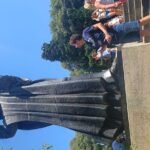
Next is the Grgur Ninski Statue, located outside one of the palace’s principal gates. It’s a statue you’ll notice because it sits right in the flow of the old town, and people treat it like a mini ritual stop.
Gregory of Nin is described as a medieval bishop who pushed back against the Catholic Church in Rome and insisted on the Croatian language in Catholic services. The idea is that people could understand what was being said, rather than everything being delivered in Latin.
The statue itself was crafted by Croatian sculptor Ivan Meštrović in 1929, commemorating one thousand years since Gregory historically defended Croatian culture. There’s also the playful custom: rubbing his big toe is said to grant your wish.
Stop time is about 10 minutes. If you’re traveling with someone who likes traditions and quick photo rituals, this is an easy win. If you’re more serious, use it as your moment to connect medieval identity to the Roman bones under your feet.
People’s Square (Pjaca) and Fruit’s Square: Split’s street life has a past
Now you shift from grand stone to the everyday social heart of Split—two squares that act like outdoor living rooms.
Pjaca (People’s Square / Narodni Trg)
You’ll hear Pjaca’s real story: it was first mentioned in the 13th century as St. Lawrence’s Square and became Split’s first inhabited area outside the palace walls. It’s been the city’s authority center for centuries, with buildings like the Old Town Hall (now used as an exhibition center).
You’ll also get a sense of continuity. The square is where local life still happens, but now it’s expressed through bars, restaurants, and shops. It’s the kind of place where photos look real because the people and activity are part of the frame.
Expect about 15 minutes.
Fruit’s Square (Trg Brace Radic)
Then you go to Trg Brace Radic, where the landmarks are compact but striking. The biggest feature is an octagonal Venetian tower, a leftover from a fortress built in the 15th century for defense of a small town.
Across the way, you’ll see the Milesi palace with a Baroque facade—one of the best examples of that style in Dalmatia, according to the tour description. Right in front stands a monument to Marko Marulić, tied to Croatian literature and philosophy.
This stop is shorter—around 10 minutes—but it’s a good moment to notice how many different eras can share one frame in Split.
Prokurative and Republic Square: Venetian-style arches in Dalmatia
The final major stop is Prokurative (Republic Square). The description is deliberate: it resembles Venice’s St. Mark’s Square, with neo-Renaissance buildings and arches around the square.
You’ll learn the name comes from arches found on the surrounding buildings. The Prokurativa building project is tied to Antonio Bajamonti, a mayor who wanted Split to show support for Italian tradition in the mid 19th century. This is where the walk becomes about cultural influence, not just dates.
You’ll also hear about a theater Bajamonti built on the square that was later destroyed by fire. That’s not the kind of detail you always catch on a standard walk, and it gives the place personality.
Expect about 10 minutes. Even if you’re not into architecture, you’ll leave with a clear mental image of where the city’s event energy tends to gather—alongside cafés and bars.
How the 2.5-hour format helps you enjoy the rest of the day
This tour is built to last about 2 hours 30 minutes, and then it ends back at the meeting point. That structure is a gift. You get orientation, context, and photos, then you’re free to keep exploring without feeling like you’re “still on schedule.”
Because it’s private, you can slow down for:
- Photo angles at the palace gates and squares
- Extra questions about how Roman design shaped medieval and modern Split
- A bit of breathing room in the cathedral area
And because you’re walking between major nodes, you can plan your next step easily. Afterward, you’ll know which direction to head for food, which lanes are worth lingering in, and where you got your bearings.
Should you book this Split walking + photo tour?
I’d book it if you want a guided route through Split’s Roman core with a pro photographer and you’ll actually use the photos afterward. It’s also a solid fit for people who arrive with limited time—cruise day, quick city break, or a first visit—because the tour is designed to connect the main landmarks in a logical flow.
Skip or downshift on expectations if:
- Your budget is tight and you only want free walking sights.
- You’re allergic to outdoor time and you’re visiting in poor weather patterns.
- You mainly want deep museum-style time rather than a walking, story-driven route.
My practical advice: confirm your details ahead of time and keep the contact method ready in case anything changes. The experience notes easy communication, and that’s exactly what you want to rely on if your day is already busy.
If your goal is to leave Split with both good photos and a clear understanding of how the city grew from Diocletian’s plan into the old-town layout you’re walking today, this private tour is a strong match.
FAQ
How long is the private Split walking tour with the photo session?
It lasts about 2 hours 30 minutes (approx.).
Where does the tour start and end?
It starts at Obala Hrvatskog narodnog preporoda, 21000, Split, Croatia and ends back at the same meeting point.
What language is the tour offered in?
The tour is offered in English.
Who provides the photography during the tour?
A private professional lifestyle photographer, Ivan Gudić, is included.
Are any admissions required during the walk?
Most stops list free admission, but Saint Domnius Cathedral and related areas are listed as 25 Croatian kuna (about 3.5 euros).
Is the tour private?
Yes. It is a private tour/activity, and only your group participates.
What if the weather is bad or you need to cancel?
The experience requires good weather. It also offers free cancellation up to 24 hours in advance for a full refund.