REVIEW · SPLIT
History Split Walking Tour in French -Small group
Book on Viator →Operated by Ancient Tours · Bookable on Viator
Diocletian’s palace feels like a puzzle. A French guide turns the stone maze of Split into a clear story, from how Diocletian rose to power to what each space meant in daily life. I also like the way the tour keeps its focus on the big, important highlights rather than scattering you around for random photos.
What I like most is the small group feel (up to 30 people) and how most stops are low-friction: you’re handed the context and the directions, and many parts come with free admission. The one thing to plan around is movement: it’s not recommended if you have issues with high steps.
In This Review
- Key highlights if you want Split to make sense fast
- Diocletian’s Palace: why this walk works in 90 minutes
- Price and what you’re really paying for ($69.14)
- Your French walking route: stop-by-stop meaning (and how to enjoy each one)
- Stop 1: The Peristyle of Diocletian’s Palace (about 15 minutes)
- Stop 2: Vestibulum of Diocletian’s Palace (about 5 minutes)
- Stop 3: Diocletian Palace substructures (about 10 minutes)
- Stop 4: The Golden Gate (about 10 minutes)
- Stop 5: Riva Harbor (about 15 minutes)
- Stop 6: Fruit’s Square (Trg Brace Radic) (about 10 minutes)
- Stop 7: Split Synagogue (about 10 minutes, pass-by)
- What the guides do especially well (and why French matters)
- Walking, steps, and comfort: what to expect in real terms
- Is it worth it for you? Who this tour fits best
- Should you book this French Split walking tour?
- FAQ
- How long is the French walking tour in Split?
- Where does the tour start?
- Where does the tour end?
- Is this tour in French?
- How many people are in the group?
- Is admission included for all stops?
- Is the Split Synagogue visited inside?
- Is the tour suitable if I have trouble with steps?
Key highlights if you want Split to make sense fast
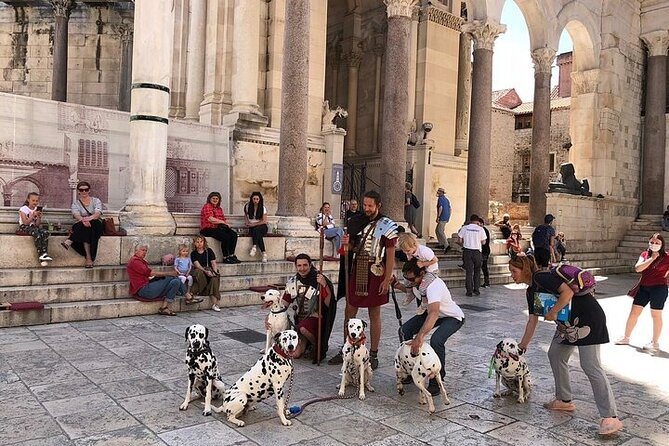
- French-led clarity: you’ll get a guided narrative that connects the palace to Split’s wider story.
- Small-group pace: up to 30 people, with time for questions and a personal feel.
- Most stops are ticket-free: you visit several major palace landmarks without extra site costs.
- Gregory of Nin and the language angle: the Golden Gate stop links monuments to Croatian identity.
- Riva Harbor orientation help: a bronze model gives you a “where-is-everything” moment.
- Synagogue stop is a pass-by: you’ll learn about it, but the synagogue admission itself is not included.
Diocletian’s Palace: why this walk works in 90 minutes
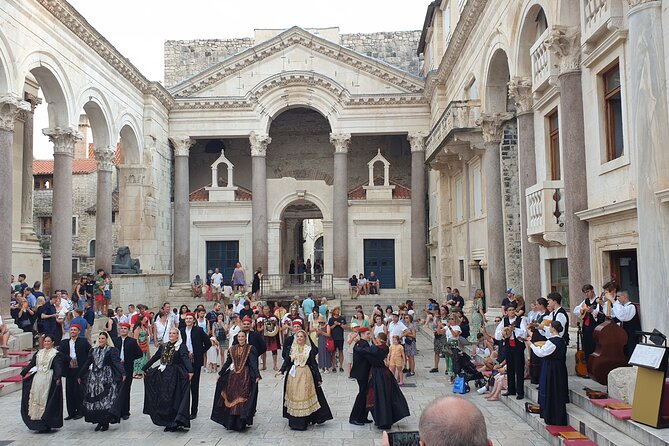
If you’ve ever wandered Diocletian’s Palace in Split, you know the challenge: you’re surrounded by walls and doorways, but it’s hard to tell what you’re looking at. This French walking tour is built for that exact problem. It guides you through the palace’s key public spaces and entrances first, then expands outward to the areas that shaped modern Split.
You’re not just ticking off landmarks. You’re learning how the palace worked as a structure, and how the story of Diocletian’s rise and rule connects to the city around it. The guide focus is on making the place intelligible—what you’re seeing, what it meant, and why it matters today.
Also, the time length is friendly. It’s listed as about 1 hour 30 minutes, but it can run a bit longer in practice. That’s a good sign: when a tour has enough material and enough crowd energy, you don’t feel rushed into a photo line.
You can also read our reviews of more walking tours in Split

Price and what you’re really paying for ($69.14)
At $69.14 per person, this is not a “free walking tour” deal. The value comes from three practical things you get for that money:
First, you’re paying for a live guide who’s comfortable speaking French and explaining details in a way that clicks. Multiple guides are highlighted by name in the offered experience—Antonela and Irene—each described as friendly, engaged, and able to answer questions. That matters because Diocletian’s Palace is confusing if you go in cold.
Second, you get an efficient route. The tour is structured around the palace’s most recognizable and explanatory stops: Peristyle, Vestibulum, the substructures, the Golden Gate, then Riva Harbor and Fruit’s Square, ending with a pass-by of the Split Synagogue area.
Third, you’re not stacking extra costs everywhere. The tour notes that admission tickets are free for most stops. The main exception is the Split Synagogue admission, which is not included. In other words, you’re mostly paying for interpretation, not constant entry fees.
One quick note: gratuities aren’t included. If you’re the type who likes to reward good guiding, plan for that.
Your French walking route: stop-by-stop meaning (and how to enjoy each one)
The tour loops back to the start point at the end, and it begins at Peristil ulica (Peristil ul.), 21000, Split. Expect to walk within the palace complex and the nearby historic core—compact, but still a real walking tour.
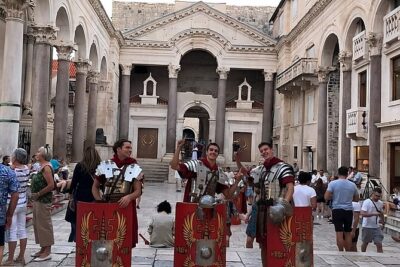
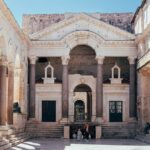
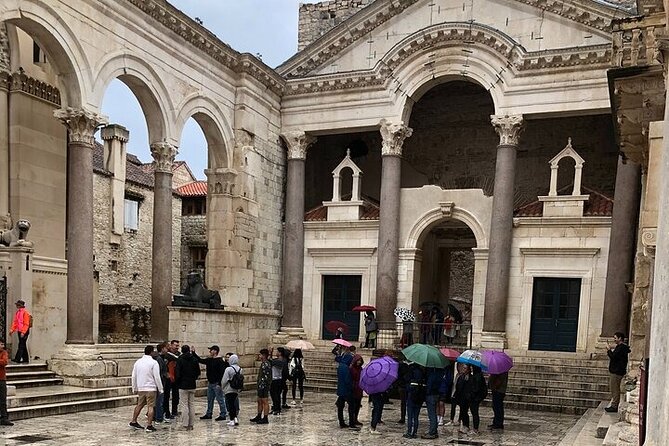
Stop 1: The Peristyle of Diocletian’s Palace (about 15 minutes)
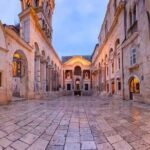
You start in the palace’s central square, and that’s exactly the right move. The Peristyle is the hub that connects to many other locations inside the complex. When a guide anchors you here, the rest of the route stops feeling random.
In practical terms, I’d treat this as your orientation stop. Listen carefully to how the guide describes movement through the palace and the role of this central space. Even if you later forget some dates, you’ll remember the “how this place fits together” idea.
Admission: free for this stop.
Stop 2: Vestibulum of Diocletian’s Palace (about 5 minutes)
Next is the Vestibulum, the vestibule linked with emperor Diocletian. This is a short stop by design. It’s not meant to stall; it’s meant to add texture.
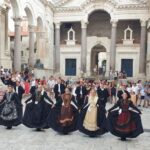
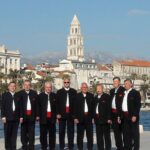
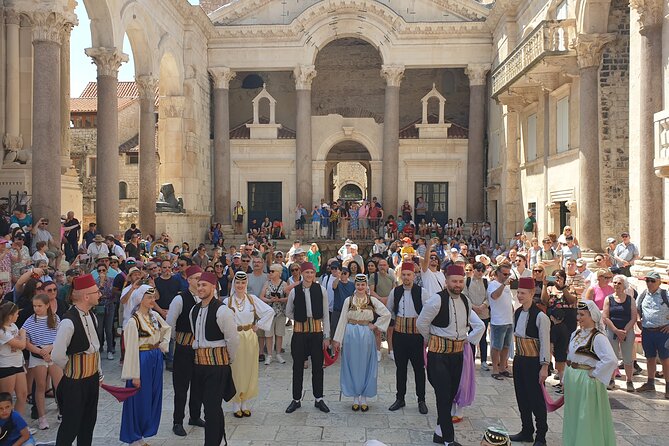
You might even hear traditional Dalmatian singing during this part. If it happens, it’s one of those moments that turns the palace from a stone exhibit into something human—sound and tradition in the middle of ancient architecture.
Admission: free for this stop.
You can also read our reviews of more historical tours in Split


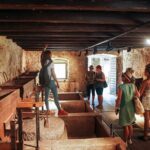
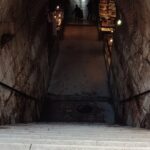
Stop 3: Diocletian Palace substructures (about 10 minutes)
Then you move into the substructures area. This is where the tour earns its keep for people who don’t just want pretty streets. You learn about construction and what these spaces did over time.
Important detail: you’re not brought into the museum portion during the tour. If you want more depth, you can go back later on your own. I like tours that separate “guided highlights” from “optional deeper study,” because you keep control of your time.
Admission: free for this stop.
Stop 4: The Golden Gate (about 10 minutes)
The Golden Gate is one of the palace’s most memorable entries. Here, the guide connects architecture with identity.
You’ll also look at the statue of Gregory of Nin and hear why his importance stretches into Croatian history and language. That’s a smart teaching angle. It keeps you from thinking of monuments as isolated objects. They’re part of how people remember and name themselves.
Admission: free for this stop.
Practical tip: take a second to look at the gate like a frame. Even if you don’t recognize all the carvings, you’ll understand where this entrance fit into the palace’s power and flow.
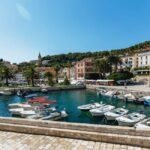
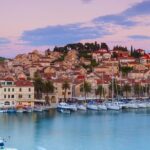
Stop 5: Riva Harbor (about 15 minutes)
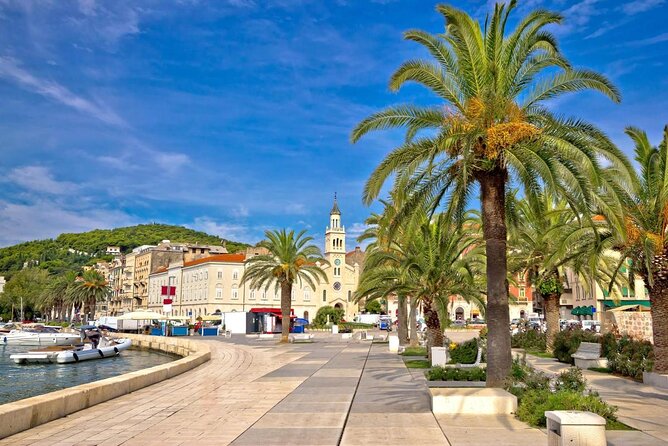
After the palace core, the tour shifts to Riva Harbor, and it does so with a helpful visual tool: you’ll see a bronze model of Diocletian’s Palace.
For me, this is a great “lightbulb” stop. Models are not just decoration—they help you map what you just heard. If you’ve been picturing the palace wrong in your head, this is where you can correct it without feeling silly.
You’ll also learn about the history of Split’s Riva promenade. That part matters if you’re enjoying the waterfront already. The guide makes it more than scenery.
Admission: free for this stop.
Stop 6: Fruit’s Square (Trg Brace Radic) (about 10 minutes)
Next is Fruit’s Square (Trg Brace Radic). This stop adds civic and cultural context.
You’ll hear about a 15-century Venetian citadel and learn about Marko Marulić, described as the father of Croatian literature. This is a good pivot from Roman structures to the language and ideas that came later.
If you like history that connects to culture—who wrote what, who shaped identity—this is the kind of stop you’ll appreciate more than you expect.
Admission: free for this stop.
Stop 7: Split Synagogue (about 10 minutes, pass-by)
The final stop is the Split Synagogue, from which you’ll learn about the history of the Jewish people in the city of Split.
One practical note: you pass by it during the tour. The tour indicates admission is not included here, so don’t assume you’ll be going inside as part of the walk.
If you care about this subject, you may want to follow up on your own after the tour. But as a closing beat, it broadens the story beyond rulers and monuments—into community history.
Admission: not included for this stop.
What the guides do especially well (and why French matters)
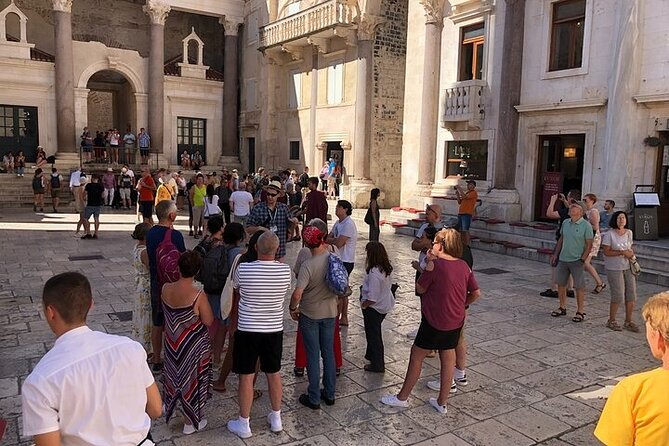
A big theme in this experience is that the guide isn’t just reading facts. Guides are described as friendly, funny, and very comfortable answering questions—even ones that go off-script.
In particular, Antonela and Irene come up as names tied to strong guiding. You can also tell the tour was designed for French speakers who want substance, not watered-down sightseeing. The narration is built around how to understand the palace, not just how to stand in front of it.
If you’re traveling in French already, this is a nice way to practice with real content. If your French is basic, it still can work because the landmarks and the structure of the route do a lot of the teaching for you.
Walking, steps, and comfort: what to expect in real terms
This is a historic-center walk with a strong palace component. The tour explicitly says it’s not recommended for travelers who have issues with high steps. So if stairs and uneven steps are a problem for you, consider another option.
On the bright side, the tour is short enough that you can pace yourself. It also returns to the meeting point at the end, so you’re not hunting for a finish-time escape.
If you need to stop often, it helps to start with a slower pace at the beginning. The tour spends the most time explaining early on, so being comfortable at the first stops makes the rest easier.
Is it worth it for you? Who this tour fits best
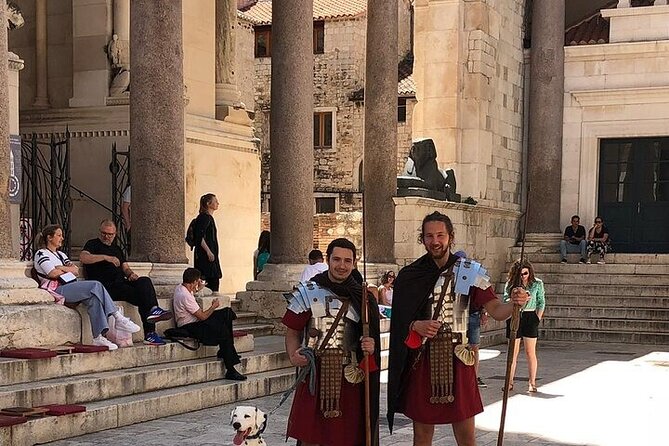
This tour is a solid match if you want:
- A French-language guide to help you understand Diocletian’s Palace without guesswork
- A route that hits major highlights in a short time
- Clear explanations of how the palace spaces connect to Split’s identity and culture
It’s also a family-friendly pick. Guides are described as making it engaging for kids, which often comes down to good pacing and plain storytelling.
If you only want a quick stroll for photos, you might find it more structured than you prefer. But if you like learning what you’re seeing, the time investment makes sense.
Should you book this French Split walking tour?
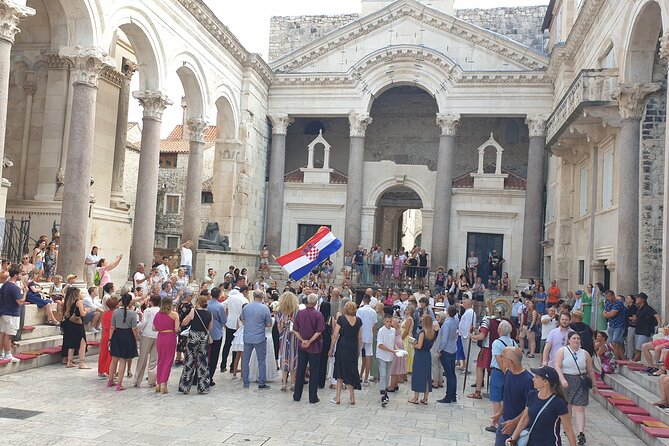
If your goal is to leave Split with an actual grasp of how Diocletian’s Palace fits together—and why the landmarks matter—this is a strong choice. The route is built around the places that help you orient yourself, and the guide-led French narrative is clearly the main value.
I’d book it if:
- You’re comfortable walking through old stone streets and steps don’t scare you
- You want most stops with free admission and only one likely exception (the synagogue admission)
- You care about how monuments connect to language, culture, and community story
I’d think twice if:
- High steps are a deal-breaker for your mobility
- You’d rather explore at your own pace with no structured explanation
FAQ
How long is the French walking tour in Split?
The tour is listed at about 1 hour 30 minutes (approx.), and it can run longer in practice.
Where does the tour start?
It starts at Peristil ulica (Peristil ul.), 21000, Split, Croatia.
Where does the tour end?
It ends back at the same meeting point.
Is this tour in French?
Yes, it is a walking tour in French.
How many people are in the group?
The tour has a maximum of 30 travelers.
Is admission included for all stops?
Admission is free for most stops, but the Split Synagogue admission is not included.
Is the Split Synagogue visited inside?
The synagogue is listed as a pass-by stop, and the admission is not included.
Is the tour suitable if I have trouble with steps?
It is not recommended for travelers who have issues with high steps. Service animals are allowed, and it’s near public transportation.